Culture of Oceania
Oceania's cultures blend indigenous traditions with global influences.

Our World In Data · CC BY 4.0
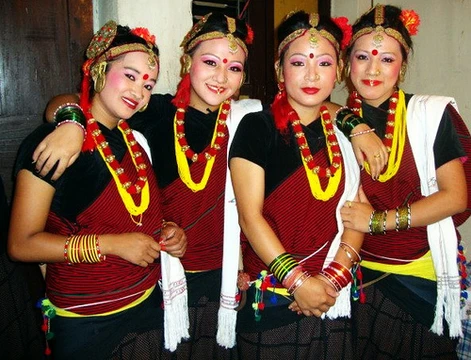
Oceanian culture encompasses the collective and diverse customs and traditions of art, architecture, music, literature, lifestyle, philosophy, politics and religion that have been practiced and maintained by the many ethnic groups of the geographical region of Oceania since prehistory. Cultures of Oceania reflect not only that of the region's indigenous peoples, but also the cultures brought by European colonisation and the United States, particularly through mass culture such as cinema and TV. Oceania is commonly divided into four geographic sub-regions, characterized by shared cultural, religious, linguistic, and ethnic traits: Australasia, Melanesia, Micronesia, and Polynesia.
- Region
- Oceania
- Sub-regions
- Australasia, Melanesia, Micronesia, Polynesia
- Cultural influences
- Indigenous, European, American, Asian
- Political systems
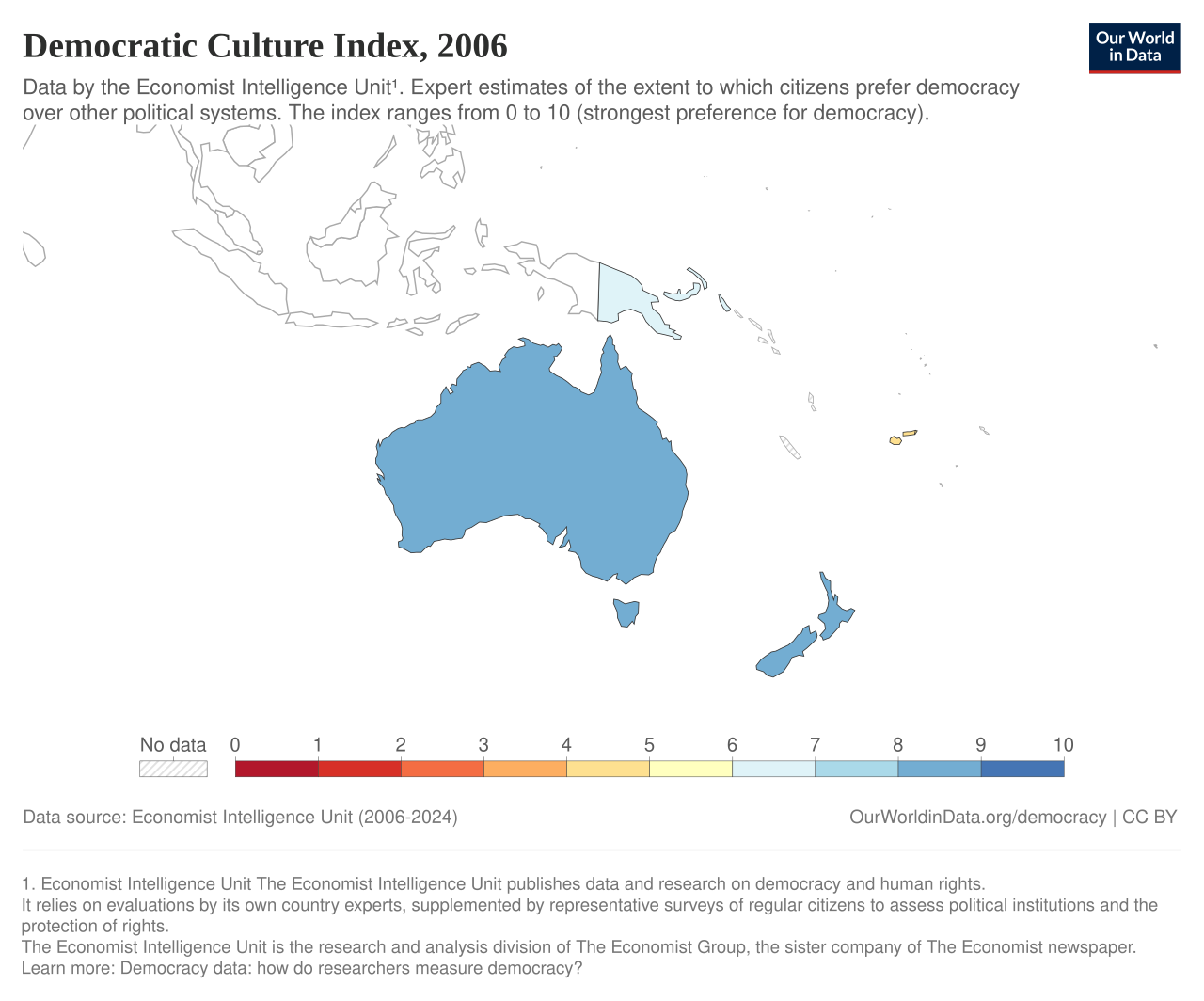
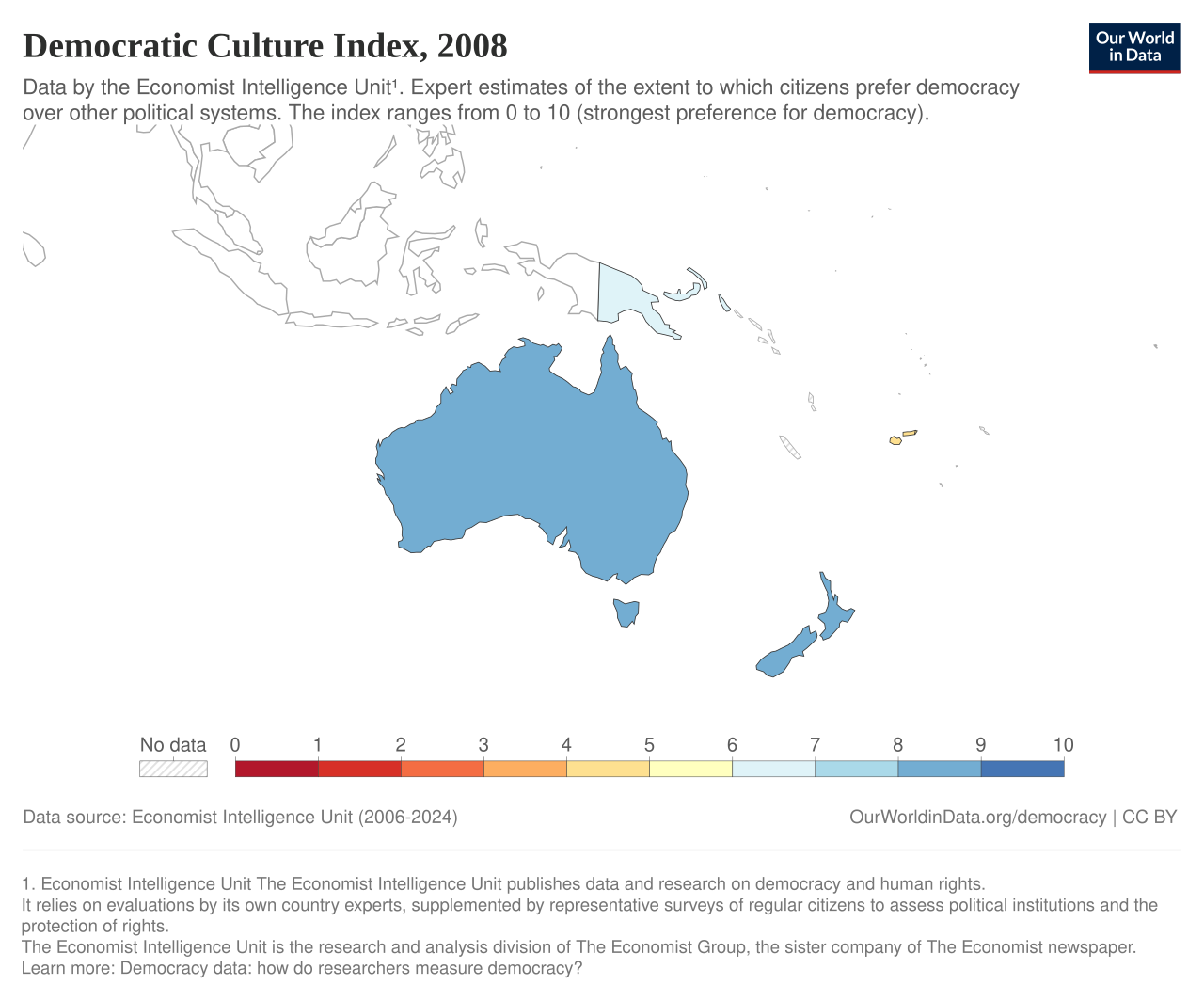
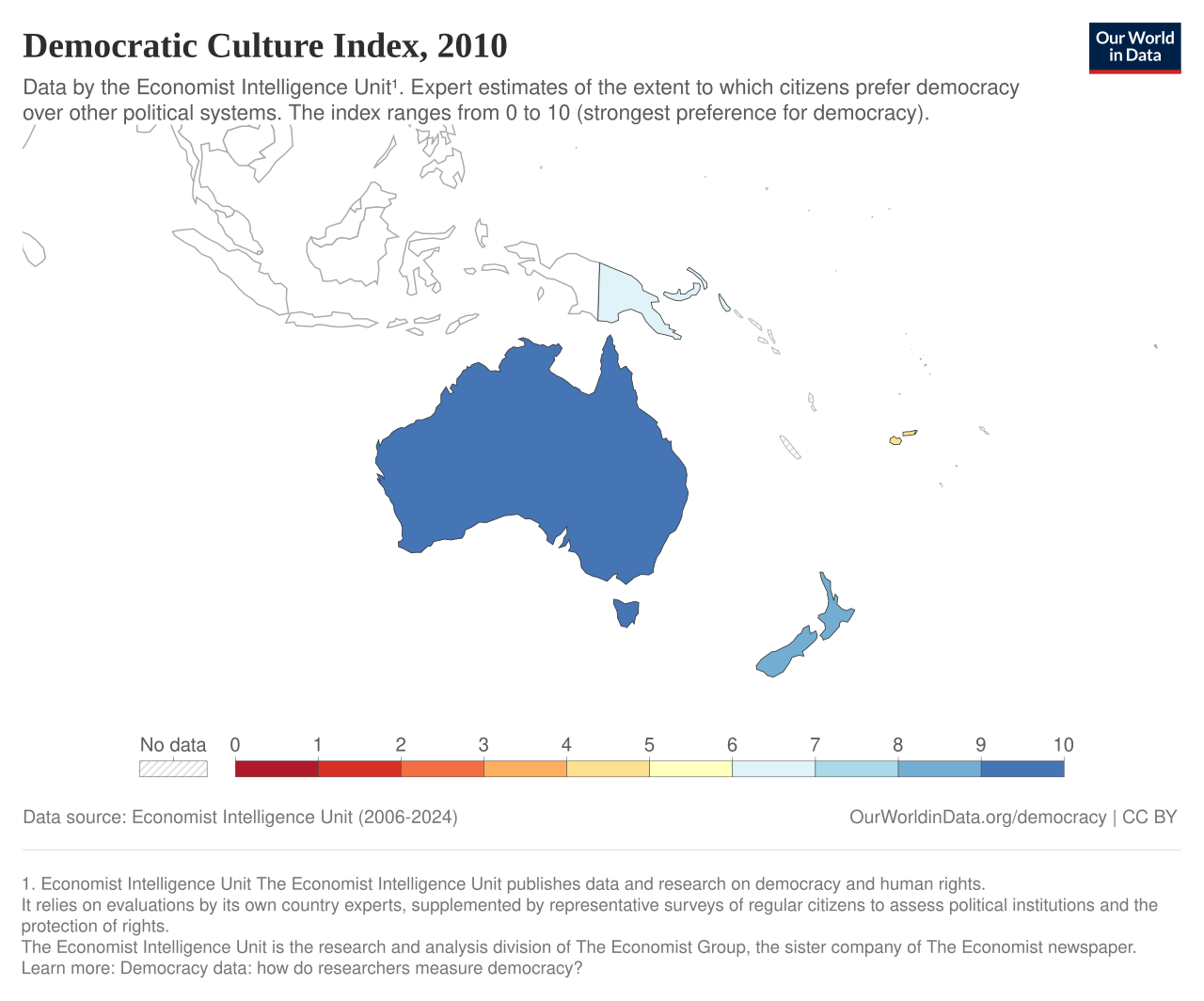
- Mostly multi-party representative parliamentary democracies
- Economic note
- Tourism is a large source of income for Pacific Islands nations
- Key cultural traits
- Diversity, syncretism, overlapping cultural spheres
Lore & Background
Oceanian culture is not a single entity but a mosaic of distinct traditions from Australasia, Melanesia, Micronesia, and Polynesia. These sub-regions share cultural, religious, linguistic, and ethnic traits, yet the cultural spheres are not mutually disjoint and can even overlap, representing the innate diversity and syncretism of human cultures and historical influences. The region's indigenous peoples have maintained practices since prehistory, while European colonisation and later American mass culture have added layers of complexity. New Zealand's early Māori adapted east Polynesian culture to a larger environment, developing a distinctive communal social organization with families, subtribes, and tribes. British and Irish immigrants introduced Christianity, and more recently American, Australian, Asian, and other European cultures have exerted influence. Non-Māori Polynesian cultures are also apparent, with the Pasifika festival in Auckland. Melanesian cultures show great diversity. In Fiji, indigenous traditions blend with Indian, Chinese, European, and Pacific influences. Vanuatu retains strong regional variations, with wealth symbolized by pigs with rounded tusks and a grade-taking system in the north. Solomon Islands reflects differentiation among groups, with seven Polynesian outliers and traditional shell-money from Malaita. Papua New Guinea is estimated to have more than one thousand cultural groups, each with its own language and expressive forms in art, dance, and architecture. The native Papuan people of Indonesia have distinct traditions, such as the stone burning tradition practiced by most Papuan tribes.
Reader's Guide
Oceanian culture matters because it represents one of the most diverse and historically layered cultural regions on Earth, spanning from prehistory to the present. The region's indigenous peoples have maintained vibrant traditions—such as the Māori communal structure, the Vanuatu grade-taking system, and Papua New Guinea's sing sings—while absorbing and adapting influences from European colonisation and American mass culture. This syncretism is not a weakness but a defining feature, as the cultural spheres overlap and evolve. The region's political systems are predominantly multi-party representative parliamentary democracies, and tourism serves as a major economic driver for Pacific Islands nations. The cultural diversity is so profound that Papua New Guinea alone has over one thousand cultural groups, each with its own language and customs. The preservation of intangible heritage, such as the stone burning tradition in Papua and the shell-money of the Solomon Islands, coexists with modern influences like cinema and TV. Understanding Oceanian culture requires recognizing that it is not a monolithic entity but a dynamic, overlapping network of traditions that continue to shape the identities of millions across Australasia, Melanesia, Micronesia, and Polynesia.
Did You Know?
- Oceania is commonly divided into four geographic sub-regions: Australasia, Melanesia, Micronesia, and Polynesia.
- In Vanuatu, pigs with rounded tusks are considered a symbol of wealth.
- Malaitan shell-money, manufactured in the Langa Langa Lagoon, is the traditional currency used in Malaita and throughout the Solomon Islands.
- The stone burning tradition is practiced by most Papuan tribes in Indonesia's Papua province.
The Mosaic of Sub-regional Identity
Oceania's cultural landscape is organized into four broad geographic sub-regions—Australasia, Melanesia, Micronesia, and Polynesia—each carrying its own constellation of shared linguistic, religious, ethnic, and cultural traits. Yet these boundaries are far from rigid. The cultural spheres overlap and interpenetrate, reflecting the innate diversity and syncretism of human cultures shaped by centuries of historical influence. A single island nation can contain societies that fall outside their expected cultural triangle, as seen in the seven Polynesian outliers nestled within the Solomon Islands archipelago. This layering means that Oceanian identity is never monolithic; it is a living negotiation between indigenous traditions stretching back to prehistory and the external currents—European, American, Asian—that have washed over the region. The result is a cultural tapestry where a Fijian village might blend indigenous ceremony with Indian and Chinese customs, while a New Zealander's sense of self draws simultaneously on Māori kinship structures and the modest, problem-solving ethos of a largely rural pioneer society.
Indigenous Social Architecture and Ritual Life
Across Oceania, indigenous communities have developed intricate social systems that organize daily life and mark the passage of time. In New Zealand, Māori society was structured around whānau (families), hapū (subtribes), and iwi (tribes), with leadership vested in a rangatira whose authority depended on the community's continued approval. Kinship roles in this system mirror those found across Polynesia, and tribal allegiance remains a vital pillar of Māori identity even today. In Vanuatu, the north operates a grade-taking system where prestige is measured by generosity—how much one can give away—while the south developed a distinct system of title grants carrying associated privileges. Pigs, especially those with rounded tusks, serve as a universal symbol of wealth across the archipelago. Coming-of-age ceremonies, often including circumcision, mark young men's transition into adulthood. Village life centers on the nakamal, a clubhouse where men gather to drink kava, with designated spaces for women during menstruation, and separate male and female zones threaded through the settlement.
Colonial Encounters and Cultural Synthesis
The arrival of European colonizers and, later, American mass culture fundamentally reshaped Oceanian societies without erasing their indigenous foundations. In Australia, culture since 1788 has been predominantly Western, rooted in Anglo-Celtic settlement, yet it has been continuously modified by Aboriginal traditions, successive waves of global immigration, and American cultural exports, producing a distinctly Australian character. In New Zealand, British and Irish settlers introduced Christianity and other elements that influenced Māori practice, and from the early 1900s through the late 1960s, Māori culture was actively suppressed as the state pushed assimilation into a British New Zealander mold. The tide turned in the 1960s with expanded tertiary education and urban growth, allowing Māori and broader Pacific identities to reassert themselves. Fiji offers another model of synthesis: indigenous Fijian traditions remain vibrant and central to daily life, yet Indian, Chinese, European, and neighboring Pacific influences—particularly from Tonga and Samoa—have woven together into a unique multicultural national identity, showcased on global stages from the 1986 Vancouver World Exposition to the 2010 Shanghai World Expo.
Material Culture, Arts, and National Symbols
Oceanian material culture and artistic traditions reveal the deep connection between communities and their specific environments. In the Solomon Islands, crafts span woven objects, carved wood, stone, and shell artefacts, with styles varying by province. Malaitan shell-money—small polished shell disks drilled and strung together, manufactured in Langa Langa Lagoon—serves as traditional currency across the archipelago, while the Tectus niloticus shell is harvested for pearl buttons and jewellery. In New Zealand, national identity is encoded in symbols drawn from nature, history, and Māori heritage: the silver fern adorns military insignia and sporting uniforms, and a body of popular cultural items unique to the country is affectionately termed "Kiwiana." Rural imagery and themes persist in New Zealand's art, literature, and media, echoing the rugged, industrious problem-solving image forged by early pastoral life. The "tall poppy syndrome," a cultural expectation of modesty that punished high achievers with harsh criticism, shaped social attitudes for generations. In Fiji, the multicultural identity is expressed through vibrant everyday traditions that remain integral to the majority of the population's daily existence.
Gallery
More in National Cultures And Ethnic Groups 1-24
Spotted an error? Know more?
This is a living reference — every entry is fact-audited, and reader corrections feed straight into our audit queue. Suggest an edit · See this site's audit record